The quest for origins
Across cultures, people have sought to understand where the world came from and what laws sustain it. They spoke in different mythologies, yet always circled the same mysteries: the void from which all things arise, the flow of time that holds them, and the duality through which life moves.
🌀 Chaos: the Primordial Void
In Greek cosmogony, the beginning was Chaos (Χάος) — not disorder, but a yawning abyss, the original emptiness pregnant with every possibility. From this gaping void emerged Gaia, Tartarus, Eros, Erebus, and Nyx: earth, abyss, love, darkness, and night.
Chaos is not destruction but potential, not the end but the opening of all beginnings. Philosophers saw in it the space of creation, psychology interprets it as the archetype of the unconscious, and modern science glimpses it in quantum fluctuations, chaos theory, and the singularity of the Big Bang. Chaos reminds us: it is in moments of uncertainty and collapse that new worlds are born.
☯️ Yin and Yang: the eternal dance
In Chinese thought, the cosmos is shaped not by a void but by the interplay of Yin and Yang — two forces born from the Great Ultimate (Tai Ji). Yin is feminine, receptive, lunar, nocturnal. Yang is masculine, active, solar, radiant.
They are not enemies but partners in an endless dance, flowing into one another like night into day, rest into movement. The dots of opposite color within the Yin-Yang symbol remind us: in every light lies shadow, and within every darkness glimmers light.
Unlike the cosmic struggle of good and evil, Yin and Yang reveal unity through duality. They teach us that true harmony comes not by eliminating opposites, but by embracing them as parts of one whole.
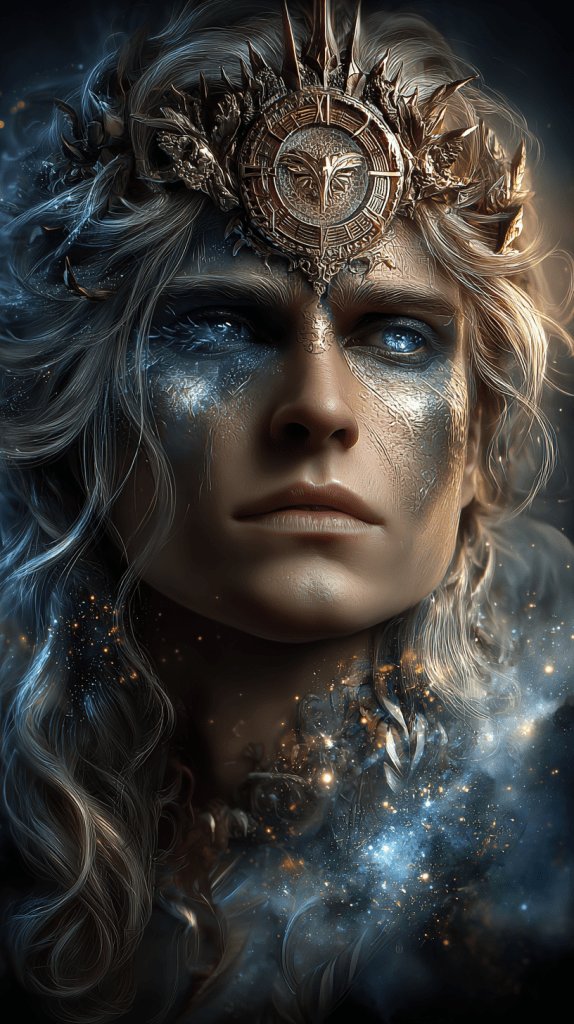
⏳ Zervan: Lord of Time
In Zoroastrian tradition, another vision emerges: at the center stands Zervan (Zurvan), the primordial deity of Time and Destiny. From him were born twin brothers: Ahura Mazda, spirit of light and order, and Angra Mainyu, spirit of darkness and deceit. Their conflict unfolds across a 12,000-year cycle, ending with the triumph of light.
Zoroastrians distinguished three dimensions of time:
- Boundless Time — eternity, without beginning or end,
- Cosmic Cycle — the great drama of good and evil,
- Personal Time — the unique destiny of each life.
Zervan embodies the paradox of existence: we cannot escape time, yet within its flow, we are free to choose our path.
🌌 A shared vision
Though born from different cultures, these three archetypes — Chaos, Yin-Yang, and Zervan — form a single mosaic.
- Chaos speaks of the void, the womb of creation.
- Yin and Yang reveal the duality that drives the rhythm of life.
- Zervan reminds us that all unfolds within the sacred flow of time.
Together they show a world that is never static: it is born, oscillates between opposites, and journeys forward in time. To contemplate them is to remember that crises can become beginnings, opposites can become harmony, and each moment can hold eternity.




 Fog & Fern Myth & Mystery in Art, Words & Light
Leave a comment